What this actually is
Most marketing tools sold to local businesses produce advice. This one produces the thing itself: the profile text you paste into your dashboard, the quote you send, the reply to the one-star review, the text message you fire off between jobs.
If you cannot paste it straight into your work, it is not finished, and it does not ship. That rule shaped every one of the twelve skills inside this pack.
The work runs in a loop. Get found in local search. Turn that attention into quotes. Turn quotes into booked jobs. Turn finished jobs into reviews, repeat work, and referrals. Then round again. Each skill owns one part of that loop, and they read each other's work so you are never retyping something you already told it.
Who it is for: owner-operators of local service businesses. Trades, salons, clinics, cleaners, personal trainers, mobile mechanics, groomers, landscapers, med spas. Anyone who serves a geographic area and wins on being nearby and trusted.
There is no assumption about your trade, your country, or your currency anywhere in the pack. It asks, and it remembers. If it does not know something it needs, you get a clearly marked blank to fill in rather than a plausible-looking number that gets published and then quoted back at you by a customer.
Start here
One phrase. That is the whole onboarding.
That runs the setup, which takes about ten minutes. It asks what you do, what your main jobs cost, where you actually work, what hours you keep, which months are genuinely busy, and how work reaches you now.
It also asks for one real message you have sent a customer. Not "what tone would you like", because "friendly and professional" describes almost every business ever and gives the rest of the pack nothing to work with. A real message shows how you open, how you sign off, whether you use contractions, and what you would never write. Everything the pack produces afterwards sounds like you rather than like an agency.
Then it does the part most tools skip. It tells you which of three things is actually holding you back:
Not enough people are finding you at all. Fixing your quotes does nothing, because nothing is arriving to quote.
People find you, call, ask a price, and then go quiet. More traffic just means more unanswered quotes.
You win the job, do it well, and never see them again. Every month starts from zero.
If you genuinely do not know where your work comes from, it says so and gives you a provisional answer, rather than dressing up a guess.
Most owners arrive certain they need more reviews. Often that is not the broken part. Working on the wrong one is not neutral, it costs months, so the setup is willing to tell you something you did not want to hear and then send you to the right skill first.
The twelve skills
You never have to learn a skill name. Say what you need in your own words and the right one opens. The names below are just so you know what is in the box.
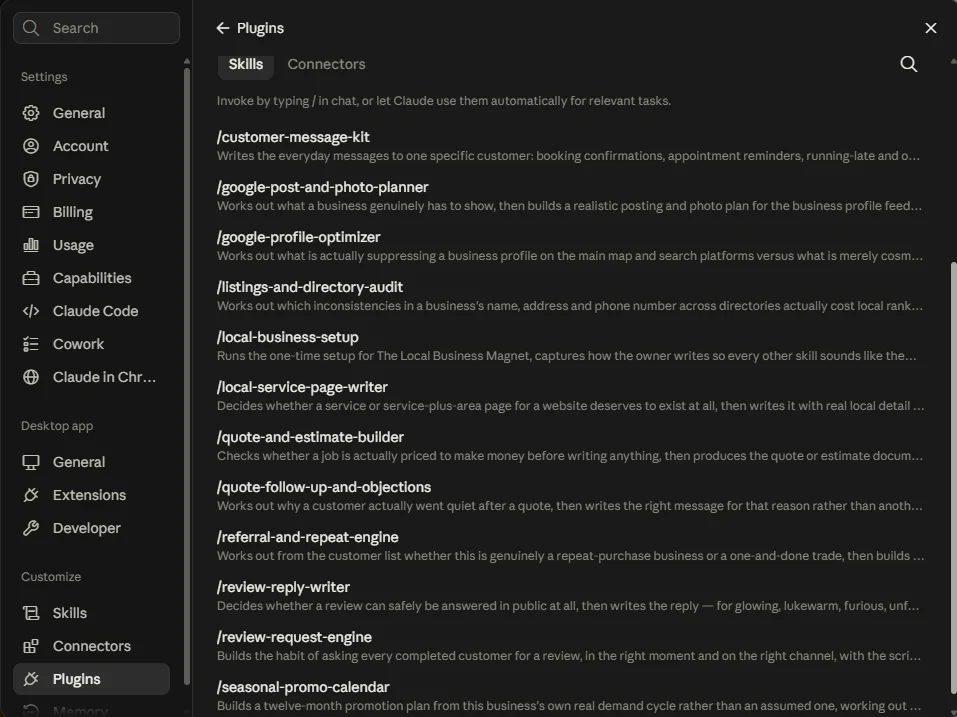
Getting found
Works out what is actually suppressing your profile versus what is only cosmetic, then writes every field to paste in. Also flags the things that get listings suspended, several of which get sold to owners as tactics.
Sorts which inconsistencies genuinely cost you rank and which are noise, then writes the duplicate removal requests. Tells you plainly when the answer is to stop adding directories.
Service and area pages with real local detail. This one refuses to write twelve versions of the same page with the town name swapped, and explains why that pattern gets whole sites penalised.
A posting and photo plan sized to the time you will actually give it, built on a twenty second capture habit. Handles trades where the finished work ends up inside a wall.
Winning the job
Checks whether the job makes money before it writes anything, then produces the quote, the options, the exclusions, the covering message, and the words to say when you present the price.
Works out why they actually went quiet. There are about eight reasons and they need different messages. Also handles "that is more than I expected" and "can you do it cheaper".
Reputation
The ask, at the right moment, for text, email, in person, and on the invoice, plus the single follow-up. Asks every finished customer the same way, and explains why.
Glowing, lukewarm, furious, unfair, and probably fake, including the reviewer who was never a customer at all.
Keeping them
Confirmations, reminders, running late, no-show follow-ups, rebooking, and waking someone up after months. Tells you when a no-show was really a missing reminder.
Works out from your own records whether you are genuinely a repeat business or a one-and-done trade, then builds the right engine for it.
A twelve month promotion plan built from your real demand cycle, not an assumed one. Includes the honest version of "I have no work on next month".
The one-time setup that everything else reads from, plus the customer list the whole pack writes to.
The part that makes these worth paying for: every skill forms a judgement before it writes. Is this job priced to make money. Is this the right moment to ask this customer. Does this page deserve to exist. A skill that only generates is a template with better manners.
The weekly radar
Alongside the twelve skills there is one background agent. It sweeps your customer list once a week and tells you what needs you.
- Quotes going cold, and which follow-up message is due on each one
- Finished jobs nobody has been asked to review yet
- Appointments in the next week with no reminder sent
- Customers drifting past their own return interval
- The season turning, particularly the weeks before your busy period
- Patterns worth knowing, like three quotes lost for the same reason or three no-shows where no reminder went out
That fourth one is the difficult one to get right, and it is where most tools of this kind become something you mute. A customer who comes back every eighteen months is not drifting at eleven. So the radar measures each customer against their own average gap rather than a blanket cutoff, and where it has no interval recorded for someone with a single job, it does not flag them at all.
Three more rules keep it quiet enough to stay useful. It flags each item once and will not repeat it unless something changes. It caps the list at seven actions and tells you how many it left out rather than quietly trimming. And it will happily tell you nothing needs you this week, which is often the honest answer.
It only reads. The radar never edits your customer list or your setup. A sweep that changes the records it is reporting on is a sweep nobody can trust.
How the skills work together
The setup creates a customer list that every other skill reads and writes. That is what stops you repeating yourself, and it is the difference between a system and a folder of prompts.
| What happens | What it feeds |
|---|---|
| You send a quote | The follow-up skill knows what is outstanding and exactly how long it has been |
| You finish a job | The review skill knows who has not been asked yet |
| A review comes in | What customers praise repeatedly becomes your profile description, in their words rather than yours |
| A customer goes quiet | The message kit and the win-back campaign both pick them up |
| Jobs accumulate | Your real repeat rate decides whether a membership is worth building at all |
| Quotes are won and lost | Three lost for the same reason becomes a finding, not three separate disappointments |
That last row matters more than it looks. A single lost quote tells you almost nothing. Three of a kind is usually the most useful thing your records will ever hand you, and it only surfaces if something is keeping count.
Connecting tools is optional
Every skill produces the finished thing in chat and as a file, always. Connectors only ever save you a step.
That is not modesty, it is the design. There is no connector for Google Business Profile and none for Yelp. We checked the directory rather than assuming. Since the business profile is the single most important surface for a local business and nothing can update it automatically, the whole pack is built to hand you text you paste in yourself, and to tell you which part of your dashboard to paste it into.
The same goes for text messages. Nothing available can send an SMS on your behalf, so every text the pack writes is written for you to copy and send. Any tool claiming otherwise is overselling what exists.
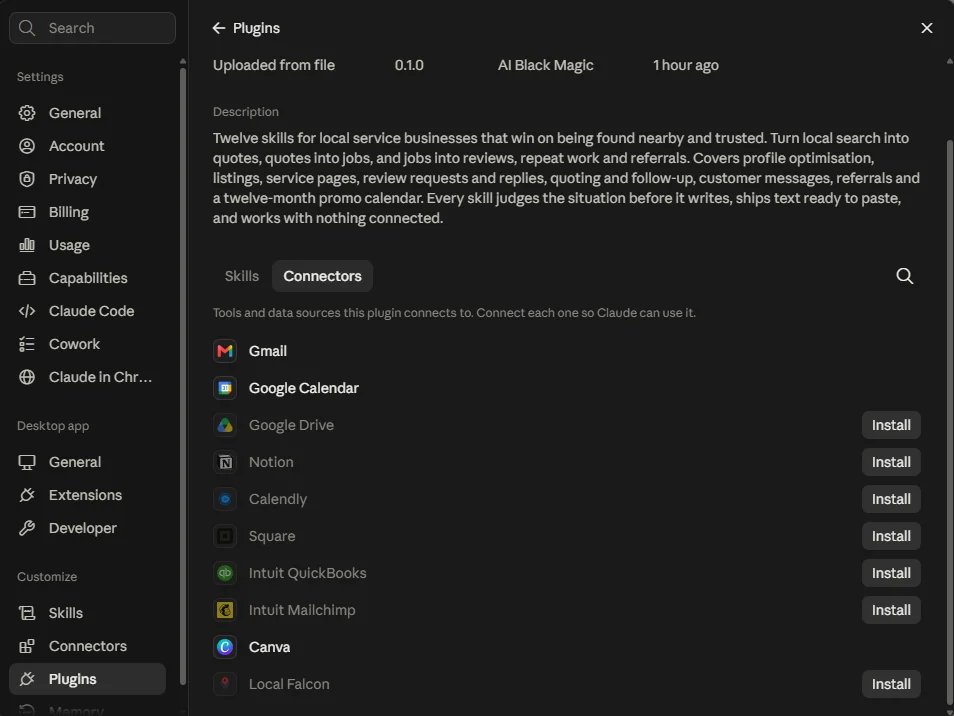
| If you connect | What it saves you |
|---|---|
| Quote covering notes and follow-ups drafted straight into your inbox | |
| Calendar | Tomorrow's bookings read automatically so reminders draft themselves |
| Documents | Quotes, audit worksheets, and your year plan saved where you can find them |
| Payments | A finished quote put where your invoices get raised |
| Design | Profile photos sized and referral cards made |
| Rank tracking | Whether your local map position actually moved after the work |
Connect nothing and everything still works. You will copy and paste more, and type a few customer names yourself. No skill will mention that something is missing, and none will stop halfway because a tool is not there.
What it refuses to do
This is the section worth reading properly, because it is where this pack differs most from the free alternatives, and because a few of the things it refuses are actively sold to local businesses as tactics.
It will not screen your customers before asking for reviews
Some tools ask customers how it went first, then send the happy ones to Google and route the unhappy ones to a private feedback form. It is called review gating, and this pack will not do it.
Two reasons, and they are different in weight. Gating is against Google's own review guidelines, which is a plain platform rule. Separately, the United States Federal Trade Commission's Consumer Reviews and Testimonials Rule, 16 CFR Part 465, took effect in October 2024, and the FTC's own guidance says that while the rule does not name selective solicitation specifically, the practice "could violate the FTC Act". What the rule does ban outright is offering money or incentives for positive reviews, and in December 2025 the FTC sent warning letters to ten businesses over exactly that. Civil penalties for knowing violations run per violation and stack. Rules elsewhere differ, so the pack flags this rather than ruling on it for your country.
There is also a practical argument, which usually lands better than the legal one. You are not choosing between a bad review and no review. You are choosing between a bad review sitting among sixty ordinary ones and a bad review sitting among nine.
It will never write a review for a customer, offer anything conditional on a good rating, or suggest wording for someone to copy. Several reviews sharing phrasing is detectable, and it breaches every platform's terms.
It handles patient confidentiality properly
If you run a dental practice, a clinic, a therapy room, or a med spa, replying to a review in a way that confirms someone was a patient, or that references their treatment, can breach health privacy law. That holds even when the reviewer published all of it themselves, and even when the review is untrue. Their disclosure is theirs to make. It does not release you.
The pack works out from your setup which of four confidentiality tiers you sit in, and switches to a reply pattern that neither confirms nor denies the relationship. It also carries a list of the phrases owners reach for instinctively that quietly confirm attendance, including the one nearly everyone writes when facing a review they believe is fake.
It will not mass-produce near-identical local pages
The request arrives constantly: write me a page for every town I cover, same page, swap the name. That is the definition of a doorway page, and action against it usually hits the whole site rather than the offending pages. So the pack refuses, explains why, and offers the version that works instead. This is the one instruction in the pack you cannot override, because complying would damage your business.
It will not invent local facts or credentials
No competitor prices. No review counts. No rank positions. No population figures. No "customers in your area" statistics. And no claim that you are licensed, insured, certified, or award-winning unless you have confirmed you hold the paperwork.
Where something is needed and unknown, you get a blank in square brackets. A blank gets filled in before you publish. An invented number gets published, and then a customer who lives there spots it.
Quotes and estimates are drafts, not legal advice. Terms, warranties, and consumer rules differ by country and trade. The pack says this on the document rather than burying it, and tells you when a question belongs with someone qualified where you are.
It will tell you things you do not want to hear
This is deliberate. A tool that only ever agrees with you is not worth paying for.
"You are asking to show up in that town. You are twenty minutes away and there are businesses in your trade based there. Your profile will not get you into that map, and trying to force it is what gets listings suspended."
"You did more jobs that month than any other, and it was your third worst month for money. That is a pricing problem, not a marketing one. Promoting harder would just fill the diary with more of the same."
"It has been three weeks and they chased you twice while they waited. I would say they went elsewhere because you were slow, not because of the price. Nothing to win back here."
"That is the third review about turning up outside the window you gave. No reply fixes that one. Want to sort the reminder messages instead?"
Nobody buys a marketing pack expecting to be told the problem is operational. Telling you anyway is the most valuable thing it will do all year.
Installing it
- Drag
the-local-business-magnet.plugininto the plugin upload dialog. That is the only installable file. - Open a new chat and say "set me up".
- Answer the setup questions. About ten minutes, and you only do it once.
- Go where the verdict sends you.
After that, just describe what you need. Some phrasings that work, none of which require you to remember a skill name:
If you ever change your prices, your hours, your service area, or your phone number, say so. The pack updates only what you named and does not restart the interview. A changed phone number or address will also prompt a listings check, because inconsistent details across directories are one of the few genuinely technical things that cost you local rank.