Most content tools help you write. This one runs the operation.
There is a gap in almost every creator's setup, and it is not the writing. You can already get a decent reel script out of a chatbot in thirty seconds. What you cannot get is the thing around the writing: knowing what you posted last month, whether it worked, what is due tomorrow, and which of the eleven drafts sitting in your notes app was actually approved.
The Content Operator is built for that gap. It is a Cowork plugin that runs a content operation end to end: research, hooks, scripts, visuals, a voice check, an approval queue, publishing, and measurement. Fifteen parts, all reading and writing to the same set of files on your machine.
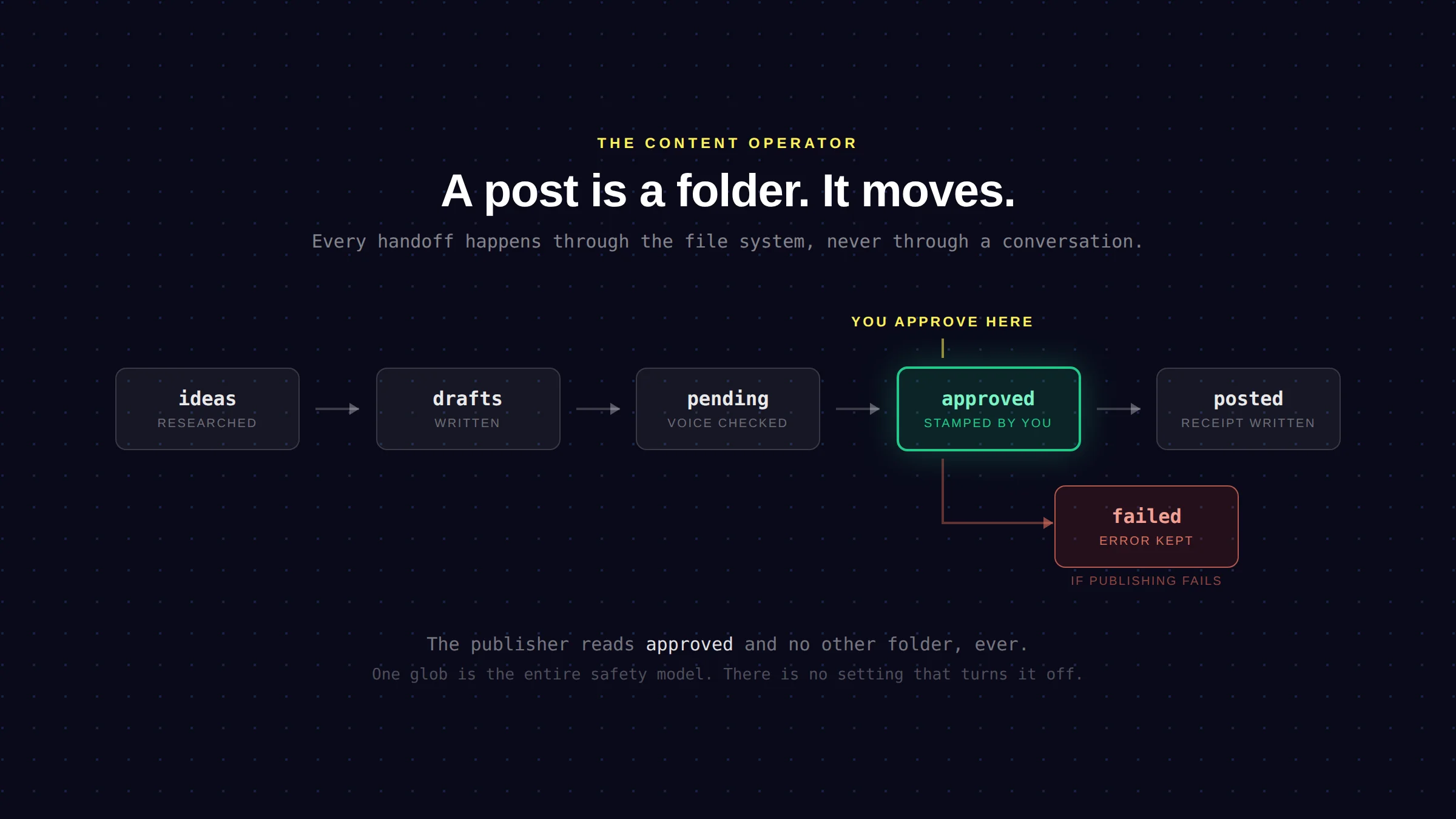
That last detail is the whole design, so it is worth slowing down on. Every part of this pack hands off through a folder, never through a conversation. The research agent writes a file. The script skill reads it and writes another. The approval queue moves a folder. The publisher reads that folder and nothing else.
Nothing talks to anything. Which means you can always answer the question "what happened?" by looking at a directory, and no part of the system can quietly do something you did not ask for. There is no manager agent, no orchestrator, no chain of prompts passing your context down a line and losing a bit of it at every hop.
One rule does all the safety work
Here is the sentence the entire pack is built around, and it is worth reading twice:
The publishing agent reads queue/approved/ and no other folder, ever.
Not pending. Not drafts. Not ideas. One folder, one glob, no exceptions.
A post cannot reach a platform unless you moved it into that folder, and the only way to move it there is to say so out loud in conversation. When you approve something, the pack stamps who approved it and when.
Most tools handle this with a setting. A checkbox somewhere labelled "require approval", switched on by default, which anyone can switch off at 11pm when they are tired and behind schedule. This pack does not have that setting. It was never built. There is no autopilot mode, no trusted flag, no configuration value that skips the gate. You cannot find it and turn it off because it does not exist.
That distinction matters more than it sounds. A default is a promise about intentions. An absent alternative is a property of the design. If a post went out, you approved it, and that is true regardless of how anyone was feeling that evening.
The five checks that run before every single post
Even once a post is sitting in the approved folder, the publisher runs five checks on it and refuses out loud, naming which one failed, if any of them does not pass.
| Check | Why it exists |
|---|---|
| You actually approved it | The approval stamp has exactly one writer, so if it is missing, somebody dragged that folder in by hand |
| Its scheduled time has arrived | Not due yet means left alone, not refused |
| The platform is still active | You might have switched Instagram off last week |
| The voice check passed | Or you explicitly overrode it, which is recorded |
| It has not already been posted | The double post guard, checked against the ledger |
Worth knowing: the pack was tested by trying to break it. Someone dragged a post into the approved folder by hand, with no approval stamp, and ran the publisher. It refused, and told them which check caught it. That test is part of the build, not a claim about it.
It works with nothing connected, and that is the product
This is the part users get wrong when they first look at it, so let us be blunt about it. No key. No account. No subscription beyond the Claude one you already have. The pack is not in a trial mode or a crippled demo when nothing is plugged in. That is its normal state.
With nothing connected, you get everything: research, hooks, scripts, visuals, the voice check, the approval queue, the ledgers, the weekly report. When you approve a post, it lands in a dated folder in your outbox as a finished thing, alongside a file called POST-THIS.md that says exactly what goes where. You open it, you copy, you post.
Adding a connector later changes exactly one thing: who presses the button.
| Nothing connected | With a connector | |
|---|---|---|
| Research, hooks, scripts, visuals | Identical | Identical |
| Voice check against your config | Identical | Identical |
| Approval queue | Identical | Identical |
| Where an approved post goes | Your outbox folder | Posted for you |
| Who presses post | You | The pack, after you approved it |
| Measurement | You report the numbers | It fetches what it can, you fill gaps |
Everything above the last two rows is byte for byte the same code. If you never connect anything, you are not using a lesser version of this pack. You are using the whole thing with a manual last step.
The fifteen parts, in the order a week actually runs
Ten of these are skills, which means you talk to them. Four are background agents, which run on a schedule with your laptop shut. The fifteenth is the state itself: the config, the queue, and the three ledgers everything else reads.
The ten you talk to
team-setup
The interview. Your brand, pillars, platforms, cadence, and voice rules. Ends by creating your four background tasks.
opportunity-brief
What to post about, pulled from free sources. Checks what you already posted so it never hands you the same angle twice.
hook-funnel
Ten openers written, three survive, one is chosen. Once you have real numbers it scores against what actually worked on your account.
script-room
Seven format modes. A LinkedIn post and an X thread are different crafts, and it writes them differently.
visual-director
Image prompts and cover specs for whatever generator you already pay for. No design tool required or assumed.
voice-guard
Checks a draft against your config, not a generic style guide. Rejects rather than rewrites, on purpose.
publish-queue
The approval gate. Cards in, "approve 1 and 3, kill 2, push 4 to Friday" out.
repurpose-run
One thing you already posted becomes a week of others across your other platforms.
what-worked
What actually performed, on the numbers you report. Refuses to call a pattern on fewer than three posts.
daily-standup
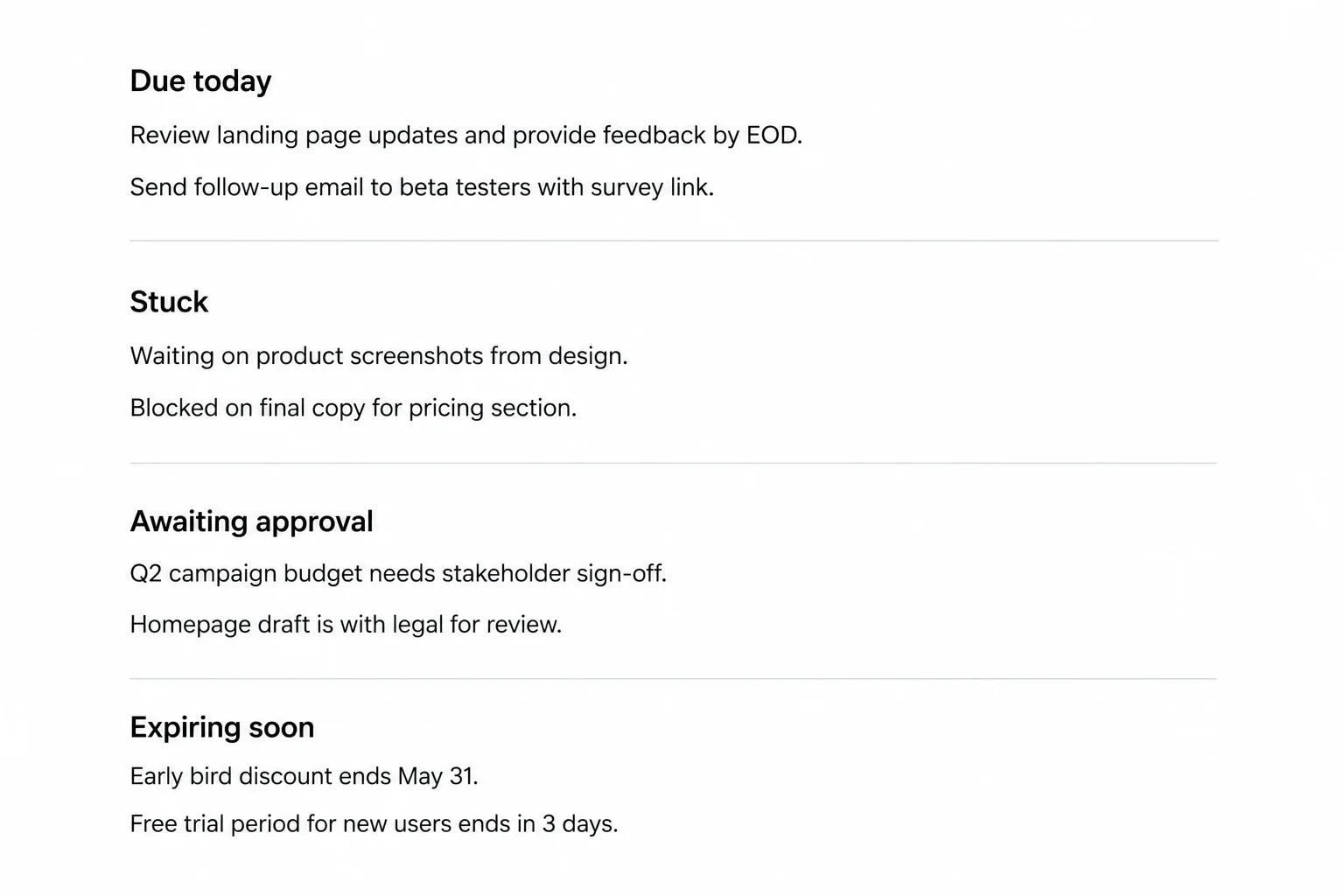
Due today, stuck, waiting on you, about to break. It writes nothing at all, which is the point.
The four that run themselves
These are created during setup as cloud scheduled tasks, so they run whether or not your machine is on. None of them can ask you a question, which changed how they were built: anything they would have asked becomes a line in the file they leave behind.
- trend-radar, daily around 6am. Scans your niche and leaves a numbered brief. If a source returns nothing, it names that source rather than padding the list to look full.
- publisher, every few hours. Reads the approved folder, runs the five checks, and either publishes or refuses in a way you can read hours later.
- performance-review, Monday morning. Writes a standalone report of your week. If you have no numbers yet, this is the thing that reminds you to add them.
- connection-check, weekly. Verifies your key still works, confirms your scheduled tasks still exist, and repairs them when your clocks change for daylight saving.
That last one is quietly the most useful. Cloud schedules run on fixed UTC times. When your clocks change, your 6am brief silently becomes a 7am brief. Nothing else in any tool you own would notice. This one recomputes it and puts it back.
Your first run, start to finish
You do not run commands. You say what you want in normal English and the right skill picks itself up from your words. Here is the whole first session. Nothing below needs a key or a subscription.
"set up my content team"
The interview. Small batches of questions, never a wall of form fields. Answer as yourself.
"what should I post about"
A numbered brief of what is moving in your niche, scored against your positioning.
"write the reel one"
Hook, script, and caption, written to that format's rules.
"visuals for the carousel"
Image prompts and cover specs you paste into your generator.
"check my drafts"
The voice gate. It passes the draft, or tells you exactly why not.
"show me what's pending"
Cards: hook, caption preview, visual, platform, scheduled time, pillar.
"approve 1 and 3, kill 2, push 4 to Friday"
Plain English in, folder moves out. Approved posts land in your outbox.
"that reel did 4,200 views"
A few days later. This is how the ledger fills when you have no connector.
During setup you will be asked whether to create four scheduled tasks. Say yes. It takes one extra exchange and it is the difference between a pack that sits there and a pack that leaves you a trend brief every morning.
Pro tip: setup asks for your timezone and it is not being polite. Everything the pack calls "today", "this week", or "due now" resolves against that one value, and the background tasks convert it to UTC for you. Get it right once and forget it.
The rhythm after week one
Once it is set up, the day to day is much smaller than the first run suggests. Most days it is two phrases.
"morning" gives you the standup: what is due today, what is stuck, what is waiting on you, what is about to break. It writes nothing and changes nothing. That restraint is deliberate, and it is why you can run it without thinking.
"show me what's pending" gives you the approval cards. You approve, kill, or reschedule in one sentence, and anything approved and due goes straight to your outbox in the same turn.
Then Monday morning the report is sitting there without you asking. And that is the loop: it produces, you judge, it records, and next week's suggestions are shaped by what you told it worked.
The honest math on your time
The pack removes production. It does not remove judgment, and it does not pretend to. At one post a day across four platforms you are still making roughly a hundred taste decisions a month. What changes is that each one takes seconds and arrives with the context attached, instead of you rebuilding it from scratch in a notes app.
Measured during testing: six commands minimum from nothing to one approved post in your outbox. Setup runs about eight exchanges. A full week of content is around eight or nine conversations.
Four design decisions worth stealing
These are the rules the pack enforces on itself. They are worth knowing whether or not you ever install it, because they apply to any AI content workflow you build.
1. Three posts, or it is not a pattern
One is an anecdote. Two is a coincidence. Nothing in the pack will claim a pattern from fewer than three posts carrying the same framework, on the same platform, with actual numbers behind them. Below that it says so plainly and scores on structure alone.
This replaced an entire ladder of confidence thresholds with one sentence that scales itself. With three data points it yields no patterns at all, and a report saying exactly that in three lines is a complete and correct report.
2. Compare engagement, never distribution
Saves, shares, and comments are things a person chose to do. Views and reach are things the algorithm chose to do. Only the first kind tells you anything about your writing.
Here is the proof from testing. Cut the same week's data on views and the reel wins, so the finding is "your reels outperform your carousels", which is true of nearly every Instagram account and tells you nothing. Cut it on saves and the carousel wins, at 37% of the views. That second finding is something you can act on tomorrow.
Apply this today, in any tool: when you review your numbers, sort by saves and shares before you sort by views. The ranking usually changes, and the new ranking is the one about your content.
3. A rejection teaches, a rewrite hides
The voice check does not fix your draft. When something is structurally off voice, it rejects it and tells you which rule it broke. That feels less helpful for about four seconds, until you notice what a silent rewrite costs you: you never learn that your voice config is wrong, so the same problem regenerates forever.
4. Never invent a number, and never invent a memory
This one came out of a real failure during the build. The writing skill was producing invented first person anecdotes as proof points. Convincing ones. Nine of them across six drafts, and one fabricated story passed every gate and reached the posted folder.
The lesson was sharper than "do not make up statistics". A made up number gets fact checked. A made up memory does not, because it sounds like something you forgot you said, and you are the one posting it under your own name.
The fix now runs through the whole pack. Anything that happened, any outcome figure, any client story, and anything a named third party said has to come from your config, the source material, or you in the moment. If none of those exist, it scaffolds the beat and marks it unmissably, and the voice check treats an unreplaced marker as a full stop.
Check your own setup for this. If you use any AI tool that writes in your first person voice, ask it for a post with a proof point and watch what it does. Most will invent a plausible personal story rather than admit it has none. That story goes out under your name.
Where it struggles, said plainly
A tool that hides its limits wastes your time later, so here they are.
YouTube is manual, both directions. The pack writes your script, your thumbnail spec, and your metadata, and then you upload. Publishing to YouTube needs a title and a privacy setting, which are real decisions the pack will not make on your behalf, and the connector does not carry YouTube analytics either. If YouTube is your main channel, know this going in.
Carousels are the most work you will do. A nine slide carousel needs nine image files before it can publish, and the pack writes prompts rather than images. Nothing warns you before the script skill happily writes you nine slides. If image generation is slow for you, ask for fewer slides.
It starts generic. The hook scoring is honest about this: with no history it says so and scores on structure alone. Your first twenty posts get a competent generic system. Around week three, once you have reported real numbers, it starts scoring against what worked on your account specifically. This is a mechanic, not a flaw, but it does mean the first fortnight feels different from the second.
Published is published. Once something is out, the ledger records it permanently. The ledgers are append only by design, which is what makes the history trustworthy, and it also means there is no undo. Corrections are new entries, never edits.
Best fit
You post regularly across two or more platforms, you already know your voice, and your problem is consistency rather than ideas.
Poor fit
You post twice a month, or YouTube long form is your only channel, or you want something that posts without you looking at it.
Adding a publishing connector, if you want one
The pack supports one connector, called Blotato, and it is genuinely optional. Skip it and everything above still works.
What it changes: approved posts get published for you instead of landing in your outbox, and the Monday report can fetch some numbers automatically instead of waiting for you to report them. What it does not change: the approval gate. Adding a key does not turn on automatic posting. Nothing publishes until you have approved it, with a key or without one.
Blotato's Starter plan is $29 per month at the time of writing, billed by them directly to you. This pack does not resell it, mark it up, or take a cut, and you can cancel it without touching anything here. Check their current pricing yourself rather than trusting a number in an article.
Read this before you generate a key. Blotato's free trial does not include API access, and generating an API key immediately ends your trial and starts the paid Starter plan. If you are still evaluating them, finish evaluating first. Getting the key is the moment you start paying.
One more thing worth saying, because honesty is cheaper than a support ticket. The connector path is newer than the rest of the pack and has had less real world mileage than the offline path, which has been tested end to end. Start without it. Add it when the loop is already a habit, not on day one while you are still learning the phrases.
Start smaller than you think
The temptation with a fifteen part system is to configure all of it on day one. Do not. The pack is built so that the first useful thing happens six commands in, and everything after that is optional depth.
Here is the honest first week. Run setup properly, and take the time on your voice rules, because the banned words and the never do list are what the voice check has to work with and a thin config means a weak gate. Say yes to the scheduled tasks. Then produce three posts, approve them, and post them by hand.
That is it for week one. Do not add a connector, do not set up all four platforms, and do not try to fill a month of calendar. Three posts through the whole loop teaches you more than thirty sitting in a queue.
Then report your numbers when you have them, even roughly. That single habit is what turns the pack from a competent writing assistant into something that knows your account. Everything clever it eventually does, the hook scoring, the pattern finding, the weekly experiment, runs on numbers that only arrive because you typed them.
The one thing to take away: the value is not that AI wrote your posts. It is that six months from now the system still knows what you published, what it earned, and which openings you have already used. Most content tools forget everything the moment you close the tab.
Open the pack and say "set up my content team". The interview takes about ten minutes, and by the end of it you will have a working operation, four background tasks running in the cloud, and a first brief waiting for you tomorrow morning.